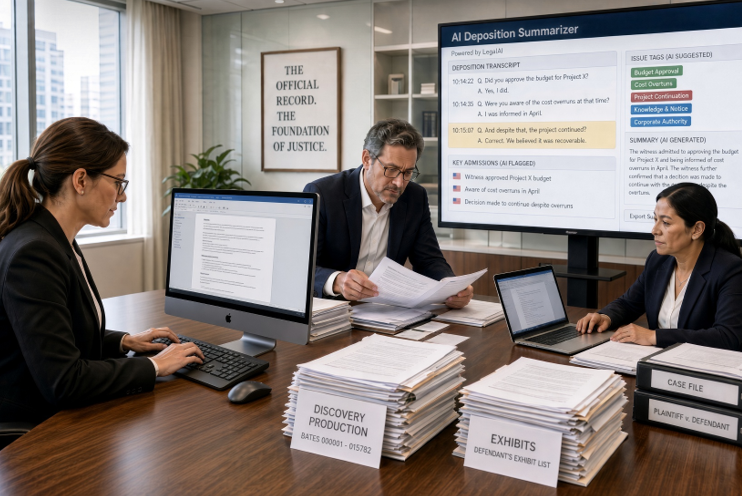
Summarization and trial-preparation tools:
• Generate condensed summaries or digests
• Flag testimony that matches user-defined issues or keywords
• Compare statements across multiple witnesses
• Produce timelines or exhibit lists tied to specific page-and-line references
These functions are only as reliable as the text they receive. An inaccurate transcript, whether from speech-recognition errors, missing speaker identification, incorrect spellings of technical terms, or omissions, can cause the software to miss key admissions, misattribute statements, or produce misleading summaries. When litigators later rely on those summaries for strategy or trial preparation, the risk compounds.
Certified court reporters address this risk by producing the official, verifiable record. They are trained to capture every word, identify speakers, and handle technical terminology. Their transcripts carry a certification that the record is true and complete. That certification is what gives the subsequent software output a foundation that can be trusted.
The Court Reporter Remains Central
The end-to-end workflow typically looks like this:
1. Live deposition: Testimony is given under oath.
2. Certified transcript: The court reporter produces the official record, often with real-time or rough draft options that attorneys can use immediately.
3. Software processing: The finalized (or rough) transcript is loaded into the firm’s chosen platform for summarization, annotation, and organization.
4. Trial preparation: Attorneys use the software’s outputs, cross-referenced back to the certified transcript, to prepare outlines, motions, and examination plans.
Remove or weaken the certified transcript, and the rest of the chain loses integrity. Rough drafts generated solely by automated speech recognition, while sometimes helpful for immediate review, are not substitutes for a certified transcript when accuracy matters for strategy or for creating a record that may later be used in court.
Experienced litigators know that small transcript errors can matter. A misheard technical term, an incorrect party name, or a missed qualification can change the meaning of testimony. When software then “summarizes” that error, the mistake is amplified across the case team. The certified court reporter’s role is to prevent those foundational errors before the software ever sees the text.
Technology makes work faster. The official record is what makes it reliable.
The use of certified court reporters simply cannot be overlooked.
Learn more at www.eCourtReporters.com